
The IET wiring regulations or the Wiring Rules as they were first known have been around since 1882, quickly becoming the standard for electrical installations across the UK. But let’s take a step back in time to look at the evolution of ‘The Regs’ and what any electrician working in your home should know.
1882 – With the world’s first public electricity supply installed into Goldaming, Surrey; replacing the gas based streetlights with electric versions. In 1882 the Rules and regulations for the prevention of Fire Risks Arising from Electric Light was published. Commonly know as the Wiring Rules, this document was circulated across government departments. It featured just 21 items, with advice to the electrician such as “Fuses are the very essence of safety. They should always be encased in incombustible cases. Even if the wires become warmed by the ordinary current, it’s a proof that they are too small for the work they have to do and ought to be replaced by larger wires”.
1887 – After the success of the First Edition, a 2nd Edition was released in 1887 with a number of new rules.
1889 – The Society for Telegraph Engineers and Electricians became the Institution of Electrical Engineers (IEE) and the IEE Wiring Regulations was created.
1897 – The 3rd Edition released in 1897 was renamed General Rules Recommended for Wiring for the Supply of Electrical Energy.
1903 – This year saw the first transatlantic radio broadcast between the United Stated and Great Britain. The 4th Edition published in the same year was the first to introduce some definitions and certification. The regulations stated that any electrician should produced a signed declaration confirming that an installation was compliant with current rules. Whilst regulation 48 stated “Fuses may be considered too large if they are not warm to the touch on full load and too small if they hiss when moistened”
1907-1916 – The 5th, 6th and 7th Editions were published in quick succession as more homes and workplaces had electricity installed. These editions were release in an attempt to keep up with the large quantity of new electrical products reaching the market.
1924 – With the UK’s first Labour prime minister in power, the 8th Edition – Regulations for the Electrical Equipment of Buildings featured different cable sizes for the first time. The National Register of Electrical Installations Contractors (NREIC) was also formed in this year, later becoming the NICEIC.
1927 – The 9th Edition was published.

Does your electrician know his wiring regs?
1934 – The 10th Edition saw the first use of separate sections, this helped electrical contractors navigate this ever growing document.
1937 – The new Electricity Supply Regulations allowed suppliers to inspect electrical connections before they were connected to public supply. Whilst the only statutory requirement of an electrician was a insulation test, this was to confirm that the installation was safe.
1939 – The beginning of World War One saw the release of the 11th Edition, with a revised issue in 1943, a reprint with amendments in 1946 and a revised section in 1948. This period saw the introduction of the ring circuit.
1950 – 12th Edition was released followed by a supplement called The Regulations for the Electrical Equipment of Building in 1954.
1955 – The 13th Edition was a major step in the world of electrical contracting as electricity supply companies began to take more of an interest in installation practices. This edition included non-mandatory recommendations on good practice for any electrician. This edition was reprinted in 1958, 1961, 1962 and 1964 mentioning PVC cables for the first time.
1966 – the 14th Edition saw the first mention of the word ‘bonding’ and was reprinted over seven times.
1970 – The 14th Edition was reprinted with metric units for the first time.
1981 – The Regulations for Electrical Installation or 15th Edition allowed for a greater level of harmonisation with the rest of Europe, following the UK joining the European Economic Community in 1973. Practices such as supplementary bonding were expanded on – regulation 413-7 required the bonding of all metallic items. This lead to the installation of supplementary bonding of baths, hand rails and boils.
This was also the first year that the coloured cover was agreed. With a cover price of £50 each reprint would be released in one of five colours – red, green, yellow, blue and brown.
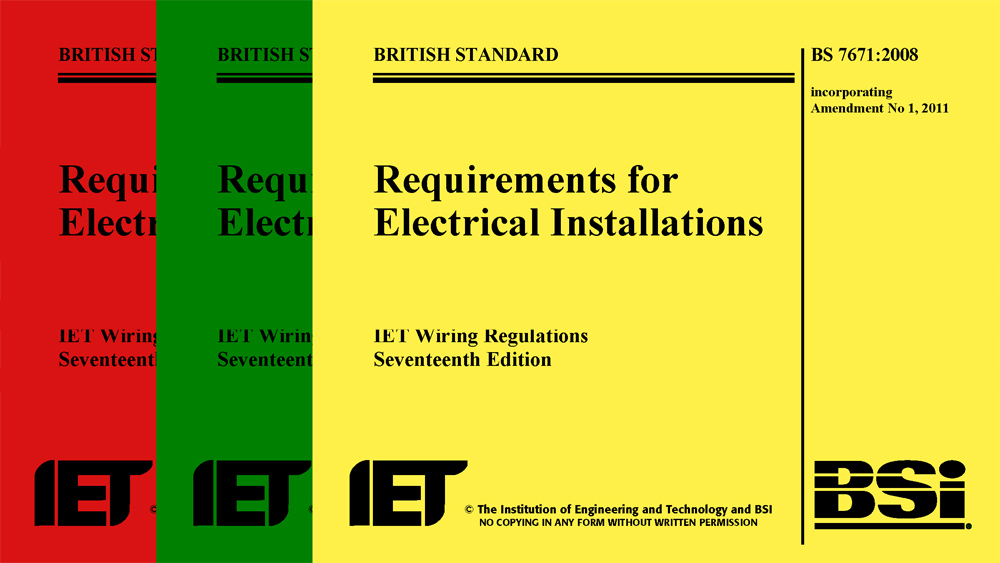
17th Edition of Wiring Regulations
1991 – The introduction of the 16th Edition also brought with it the first certificates including test results and an inspection schedule for electricians. This edition was reprinted 4 times.
2004 – the Part P of Building regulations came into operations and the 16th Edition was renamed the BS 7671:2001 requirements for electrical installation, The IEE Wiring Regulations. This made is a legal requirement for all domestic installation to comply with a set standard.
2006 – The Institution of Engineering and Technology (IET) was created by the IEE and Institution of Incorporated Engineers joined.
2007 – The 17th Edition was released after a committee of delegates representing the electrical industry reviewed the previous edition. They also welcomed comments from members of the industry to input on future regulations. This edition provided engineers with more detailed regulations surrounding the use of residual current devices or RCD’s.
2013 – The 17th Edition was amended to included a new section on electric car charging.
2015 – The last amendment made to the 17th Edition was to include information of switchgear assemblies. This led to plastic consumer units becoming obsolete due to fire risk and their metal version being installed.
2018 – This year saw the introduction of the 18th Edition, which will see all practicing electricians retrain to follow the new regulations. Issued on the 2nd July 2018, a six-month grace period allows both the 17th and 18th Editions to be practiced until 31December 2018.
We will be publishing a series of blogs on how the 18th Edition will effect your home and what to look out for when booking a electrical contractor. Keep an eye out for our blogs!


